
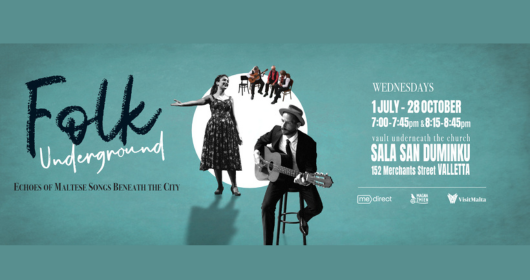
Beneath the streets of Valletta, in the stone-vaulted chambers below the Dominican Church, something happens on summer evenings that most visitors to Malta will never know exists. Voices rise. Guitars answer. Stories unfold in rhyme. And for 45 minutes, you are inside one of the oldest living musical traditions in the Mediterranean.
Folk Underground brings għana — Malta’s unique tradition of folk song, storytelling, and acoustic guitar — out of the village bars where it has lived for centuries and into the atmospheric depths of Sala San Duminku on Merchants Street. If you are looking for a cultural experience in Valletta that is genuinely unlike anything else on the island, this is it.
What Is Għana?
Għana (pronounced aana — the għ is silent) is Malta’s traditional folk music. Inscribed on UNESCO’s Intangible Cultural Heritage List in 2021, it has been described as a synthesis of North African and European music — a sound that is not quite Eastern, not quite Western, and entirely Maltese.
The tradition has its roots in the everyday life of pre-industrial Malta. Farmers sang to each other across fields. Women sang while washing clothes on rooftops. Fishermen sang on the water. What began as spontaneous, improvised verse eventually developed into a structured art form with deep rules, fierce rivalries, and a devoted community of performers and listeners.
There are three forms of għana, each with its own character:
Spirtu pront (quick-wit) is the most popular one. Two or more singers face off in improvised rhyming duels, trading verses that showcase their command of the Maltese language through wordplay, humour, double meaning, proverbs, and cutting wit. Three guitarists provide the accompaniment — one lead and two rhythm players — using locally crafted instruments with a distinctive, compact sound. Think of it as a Maltese rap battle with 500 years of tradition behind it.
Tal-fatt (factual) is a slower, narrative form where a soloist recounts a story — folktales, historical events, or humorous incidents — from memory. It is the oral tradition at its most powerful, passing stories from one generation to the next through song.
La Bormliza is the oldest and rarest form, historically sung by women, characterised by extraordinary vocal range and a style where a single syllable moves across multiple notes. It is seldom performed today, but when it is, it is mesmerising.
The Venue: Sala San Duminku
The performances take place in Sala San Duminku, a vaulted underground hall beneath the Dominican Church on Merchants Street in Valletta. The stone chambers create a natural acoustic that is perfectly suited to the raw, unamplifled power of għana voices and acoustic guitars. The intimacy of the space — small audience, low ceilings, centuries-old stone — means you are not watching a concert. You are sitting inside the music.
For anyone used to experiencing live music in large venues, the difference is striking. There is no stage barrier, no sound desk, no lighting rig. Just performers, guitars, and voices reverberating off limestone walls that have stood since the 16th century.
Event Details
- Event: Folk Underground — Echoes of Maltese Songs Beneath the City
- Venue: Sala San Duminku, Merchants Street, Valletta
- Schedule: Every Wednesday from 1 July to 5 August 2026 (6 performances)
- Dates: 1 July, 8 July, 15 July, 22 July, 29 July, 5 August
- Shows: Two sittings per evening — doors at 18:45 and 20:00
- Duration: Approximately 45 minutes per performance
- Tickets: €15 — available at showshappening.com
- Age: All ages
- Organised with the support of: MeDirect Bank Malta, Visit Malta, and Magna Żmien Foundation
- Website: folkunderground.com
Why This Matters
Għana has always been the music of ordinary Maltese life — farmers, fishermen, working-class families — and for most of its history it has lived in village bars, bocci clubs, and community gatherings that visitors rarely encounter. Unless you know a local who can take you to a Sunday morning session in a bar in Żejtun or Pietà, the chances of hearing genuine live għana as a tourist have traditionally been slim.
Folk Underground changes that. It takes the tradition out of its usual setting and presents it in an accessible, curated format — without stripping away the authenticity that makes it powerful. The performers are celebrated folk masters alongside a new generation of musicians who are carrying the tradition forward. The result is not a museum piece or a tourist show. It is a living, breathing art form performed by people who grew up inside it.
For visitors, it is also a window into a side of Malta that postcards and travel brochures never show. Beyond the bastions, the beaches, and the baroque churches, there is a rich oral culture that is woven into the Maltese language itself — UNESCO recognised għana specifically for its role in the transmission and development of the Maltese language, the only Semitic language written in the Latin script.
How to Get There from The Embassy Valletta Hotel
Sala San Duminku is on Merchants Street — a short seven-minute walk from The Embassy Valletta Hotel on Strait Street. No transport needed, no planning required.
With two sittings per evening (18:45 and 20:00), you can easily combine Folk Underground with dinner. Catch the early show, then walk to the Rooftop Restaurant & Lounge for a late Mediterranean dinner with harbour views. Or dine first, then head underground for the 20:00 sitting.
Frequently Asked Questions
What is Folk Underground?
A series of intimate live performances of traditional Maltese għana (folk singing), storytelling, and acoustic guitar, held in the vaulted underground chambers of Sala San Duminku beneath the Dominican Church in Valletta.
When does Folk Underground take place?
Every Wednesday evening from 1 July to 5 August 2026 — six performances in total. Two sittings per evening, with doors at 18:45 and 20:00. Each performance lasts approximately 45 minutes.
How much are tickets?
Tickets are €15 and available through showshappening.com. Availability is limited due to the intimate venue size, so booking in advance is recommended.
Do I need to understand Maltese to enjoy it?
Not at all. While the lyrics are in Maltese, the power of the voices, the virtuoso guitar playing, and the atmosphere of the underground venue are captivating regardless of language. The emotion, humour, and energy of the performers come through even if you do not understand every word.
What is għana?
Għana (pronounced aana) is Malta’s traditional folk music, inscribed on UNESCO’s Intangible Cultural Heritage List in 2021. It is characterised by powerful, improvised singing accompanied by acoustic guitars, and has been a part of Maltese life for centuries.
How close is the venue to The Embassy Valletta Hotel?
A seven-minute walk. Sala San Duminku is on Merchants Street, a short stroll from Strait Street where the hotel is located.
Is it suitable for children?
The event is listed as all ages. The performances are acoustic and intimate, so it works best with older children and teenagers who can appreciate the atmosphere and sit through a 45-minute show.